
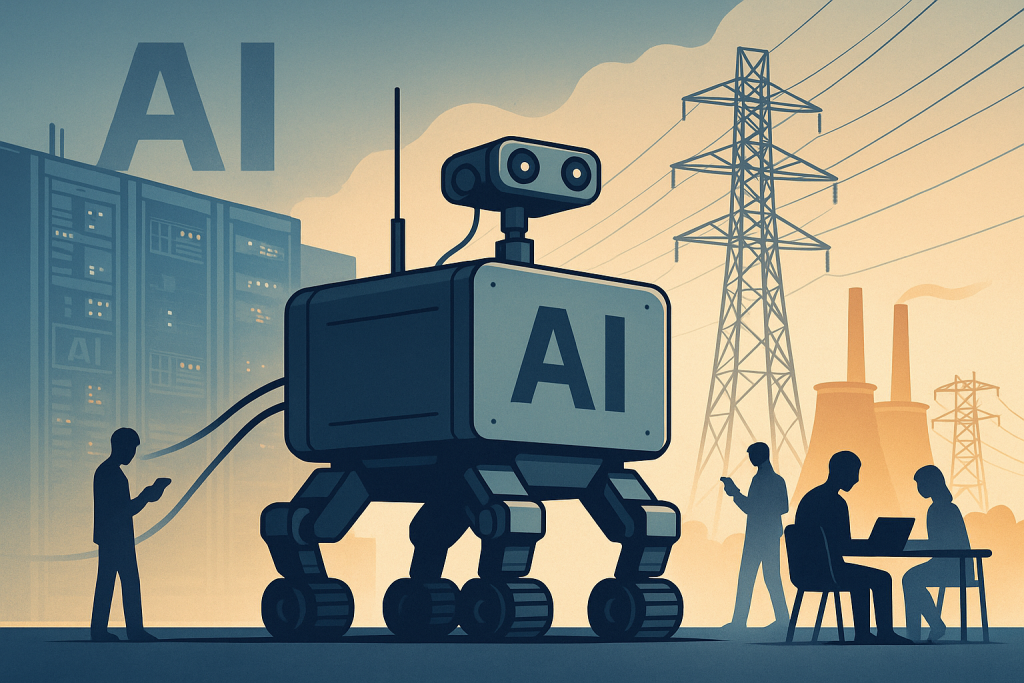
When it comes to Industrial Revolution 2.0, I believe it’s already been going on for a number of years. To me, this new phase is about how we use computers and automation, including both traditional computing and robotics. Both have been around for years—if not decades.
But with the sudden emergence of AI, I think everything has kicked into high gear. It’s changing how things are automated and the methods we use to get there. The big difference with AI and this Industrial Revolution, compared to earlier ones, is that we as consumers also have access to it. Many of the advances made in previous revolutions didn’t give everyday people access to the same tools.
And finally, before I start diving into this post, I want to be straight up and honest with you about AI. I’m a very heavy user of AI on a daily basis for a number of things I’m working on right now. That means it would be very easy for me to be biased in how I present things. I promise to be as honest as I can about both the good and the bad when it comes to AI.
AI has been in development for a number of years. But it feels like it suddenly exploded into the news and into our everyday lives. That’s kicked off a lot of conversations—both about how it’s being used in business (and which jobs might be replaced) and how it’s affecting our social lives.
Previously, both the manufacturing and business sectors were already using computers and robotics. But the way they were used was very rigid and specific. Humans set the rules, and the machines simply followed them.
On the factory floor, that meant things like:
“Robot, grab this specific item from this shelf, along this defined path,” or
“Robot, follow me and carry these loads,” or
“Do this one hard or dangerous task over and over.”
In the office, computers weren’t all that different in spirit:
“Here’s a program—run it and give me this specific report or set of numbers.”
All of this still required a lot of human input up front. People had to tell the machines exactly what to do, step by step, before any work could happen.
AI changes that relationship.
Instead of us defining every tiny step, we’re starting to ask systems to look at patterns, make suggestions, and sometimes even decide how to get from A to B on their own. For most factories and businesses, that’s the big shift: moving from “do this exact scripted task” to “help figure out how the task should be done in the first place.”
Before we get into where AI and robotics are taking us, let’s agree on a simple definition for each from MIT.
MIT EDU What is Robitcs?
” Robotics combines computer science, engineering, and technology to design, construct, and utilize machines that are programmed to replicate or substitute human actions and decision-making. These machines, known as robots, are deployed across a broad spectrum of industries to improve productivity, efficiency, and safety. Because robots can be used in so many ways, robotics is a broad, interdisciplinary field, meaning that there are many ways to study it and find a specialized career.”
In plain English: robotics is the hardware – the physical machines that can act in the real world.
MIT EDU What is AI?
“Artificial intelligence (AI) encompasses the fields of computer and data science focused on building machines with human intelligence to perform tasks like learning, reasoning, problem-solving, perception, and language understanding. Instead of relying on explicit instructions from a programmer, AI systems learn from data that enables them to handle complex problems and simple repetitive tasks, improving how they respond over time.”
In plain English: AI is the “brains” – the software that learns from data and helps make decisions instead of just following a script.
Jump to:
AI in the manufacturing sector
MITEDU What is happening with AI in the manufacturing sector.
AI technology in the manufacturing sector, which is being deployed as part of the wider Industry 4.0 movement, has already touched several types of solutions.
Industry 4.0 digital breakthroughs apply to a wide range of business scenarios, and they include:
Augmented reality and virtual reality: Augmented reality (AR) and virtual reality (VR) enable in-depth problem-solving by displaying data in immersive new ways.
Digital twin technology: Complex models that simulate the whole manufacturing process. All assets therein are invaluable for their role in scenario modeling and predictive analytics.
Sensors and the Industrial Internet of Things (IIoT): Large sensor deployments allow manufacturers to collect more production data than ever before for real-time analysis.
Machine learning analytics: The analytics algorithms underlying Industry 4.0 deployments can gain power and effectiveness when built with machine learning (ML). This is a branch of AI technology concerned with self-improving processes.
Efficiency-building generative AI systems: Generative AI (GenAI) is a major growth area and is the fuel behind systems such as digital agent technology. GenAI solutions can respond to natural-language prompts while helping employees complete actions such as searching large, complex databases and brainstorming new ideas.
Please note. Yeah, yeah, I know this series is labeled Industrial Revolution 2.0. But when it comes to AI, it’s 4.0 inside that 2.0. Computers and robotics. That’s my story and I’m sticking to it.
- On the factory floor: AI isn’t just watching machines, it’s deciding when to slow them down, when to shut them off, and when a human needs to step in before something breaks or hurts somebody.
- Quality control: Cameras and sensors tied to AI can spot tiny defects way faster than a person staring at a conveyor belt all day. That means fewer bad parts slipping through and less wasted material.
- Maintenance: Instead of “run it till it dies,” AI can look at vibration, temperature, and error logs and say, “Hey, this robot arm is acting weird, fix it Thursday before it fails on Monday.”
- Scheduling and supply chain: Behind the scenes, AI is helping plan which parts to order, which jobs to run first, and how to keep the line busy without drowning workers in overtime.
- Workers: The more data the factory collects, the more people need tools to understand it. That’s where AI assistants and dashboards start showing up in the office, not just out on the line.
So right now, AI is already all over the manufacturing world – in product design, on the line with sensors and machine learning, and in the back office helping people make sense of all this new data.
It should be noted that not all manufacturers are using AI in the ways I’ve described above. Smaller companies will be slower to adopt this technology for a lot of reasons: cost, lack of in-house knowledge, fear of losing control, or because AI simply hasn’t advanced enough yet to handle their specific manufacturing process. AI is only now really exploding into both our everyday lives and the manufacturing world. But as AI gets smarter and more companies see how it can actually help them, it will spread across more and more of the manufacturing industry.
Just like earlier industrial revolutions, the biggest players will jump in first, and the smaller shops will follow more slowly as the tools get cheaper and easier to use.
The next question is: how does all of this hook into the robots that are already doing a lot of the physical work on the floor?
AI and Robotics
When most people think about robots, they still picture the old industrial arms doing the same motion over and over on a car line. That world isn’t gone, but AI is quietly changing what robots can do and how we work with them. Instead of dumb machines that follow a script, we’re starting to see robots that can actually perceive their environment, learn from experience, and adjust on the fly.
The basic idea is simple: take all the AI stuff we’ve been talking about — machine learning, computer vision, language models — and bolt it onto physical hardware. That’s what turns a “dumb” robot into something that can work next to people instead of needing to be locked in a cage. With better sensors and smarter software, these machines can recognize objects, notice when something’s off, and even ask for help when they hit a situation they weren’t programmed for.
You can already see this in the real world. In factories, AI-driven robots can spot tiny changes in parts and automatically tweak how hard they push or where they move, without a human having to stop the line and recalibrate everything. In operating rooms, surgical robots are getting better at identifying tissue and structures so they can guide the surgeon toward safer, more precise movements instead of just being an expensive remote-control arm.
It’s not just factories and hospitals, either. Out in the fields, industrial farming already uses big machines for planting and harvesting tough crops like corn and wheat. The problem has always been the delicate stuff. Soft fruit and vegetables — strawberries, tomatoes on the vine, peaches, lettuce — bruise easily, ripen unevenly, and are buried in leaves. Humans are still better at that “feel” work: judging ripeness by touch, adjusting pressure on the fly, and twisting things off the plant without ripping half the stem out.
AI, better optics, and pressure sensitivity are what start to close that gap. With high-resolution cameras and computer vision, a harvesting robot can actually spot the fruit, judge how ripe it is, and find the stem in 3D instead of just swinging a metal arm through the plants. Add soft grippers and sensors that can feel resistance, and the robot can pick something up without turning it into jam.
There’s also a less pleasant angle nobody puts in the farm brochures: bathrooms. When you’ve got big crews working all day in the middle of a field with limited toilets or hand-washing, people go wherever they can. That’s not a “bad worker” problem, that’s a reality problem. And when you mix human waste, dirty hands, and fresh produce, that’s where you get some of those lovely food-poisoning headlines. If more of that delicate, high-risk work is being done by machines instead of big human crews, you at least remove one of those contamination paths. It doesn’t magically fix everything in the food chain, but it can quietly make things a little safer.
The big shift happening around 2025 isn’t just the tech — it’s the trust. A few years ago, AI in areas like healthcare or defense was “interesting, but risky.” Now more companies are starting to treat AI as a co-pilot, not just a fancy calculator. They’re letting it watch, recommend, and sometimes act, while humans stay in the loop.
So the real question for this section isn’t “Will robots take over?” It’s: how are AI and robotics going to work together, and what happens to the people on the other side of the safety fence when the robots stop being dumb?
So, I am sure you are wondering. How is all of this going to affect me?
AI and Robotics – Impact on Society
How is this going to affect you personally?
Well, as a society we have to face some very harsh truths — both about the past industrial revolutions and the one we’re living through right now.
- Society always changes.
Whether it’s because of an industrial revolution or just cultural shifts, society never stays still. As humans, big dramatic changes are hard for us to understand or adjust to. And those changes don’t hit everyone the same way. What feels like a massive disruption to you might only be a subtle shift to someone else. - Jobs will change. They always have.
Every industrial revolution has caused job losses in some areas and forced people to learn new skills in others. In earlier eras, the world’s population was a lot smaller, so the impact may not have felt as severe as it does now. Today, when entire industries shift, billions of people can feel it all at once. - We’ve survived this kind of thing before.
Society has gone through huge disruptions in the past and come out the other side. We will again. As humans, we’re stubborn and resilient, even when the ride is rough. Remember, we’ve survived two world wars and countless other conflicts. - Falling birth rates change the whole equation.
In a lot of Western nations, birth rates are dropping. From Japan to Europe, there are simply fewer children being born, which means populations are aging. The “experts” (for whatever their opinion is worth) say that for a country to sustain itself long-term, the average birth rate needs to be about 2.1 children per woman.
When you don’t hit that number, you end up with older workers, fewer young people entering the workforce, more demand for healthcare, and the same need for products and services. That’s where AI and robotics can actually help — stepping in to fill labor gaps and keep things running when there just aren’t enough people to do all the work. - Increased energy usage and costs
As every industrial revolution has shown, energy is the fuel that makes everything else possible. And each new wave of technology has required more energy than the one before it. AI and robotics are no different. Both require huge amounts of power — from data centers running AI models to factories full of robots that never really “clock out.”
That brings us to cost. We’re already pushing the limits of what our current energy systems can comfortably provide. And, like anything else, when supply is tight and demand goes up, prices follow. Energy for lights, heating, cooking, and basic living isn’t optional. For at least the foreseeable future, we should expect those costs to keep climbing as AI and robotics add even more load on the system.
And this leads me to the next installment in this series: Renewables and the Energy Infrastructure.
Discover more from
Subscribe to get the latest posts sent to your email.