
I know, I’m blowing off the open-source post. Sorry – it just doesn’t do much for me right now as something I want to talk about. If you ever need an alternative to a paid program, though, I know a bunch of fully free open-source applications that are proven and secure replacements for paid stuff (Microsoft Office, Adobe products, etc.). Just email me from here. I actually read my email, believe it or not.
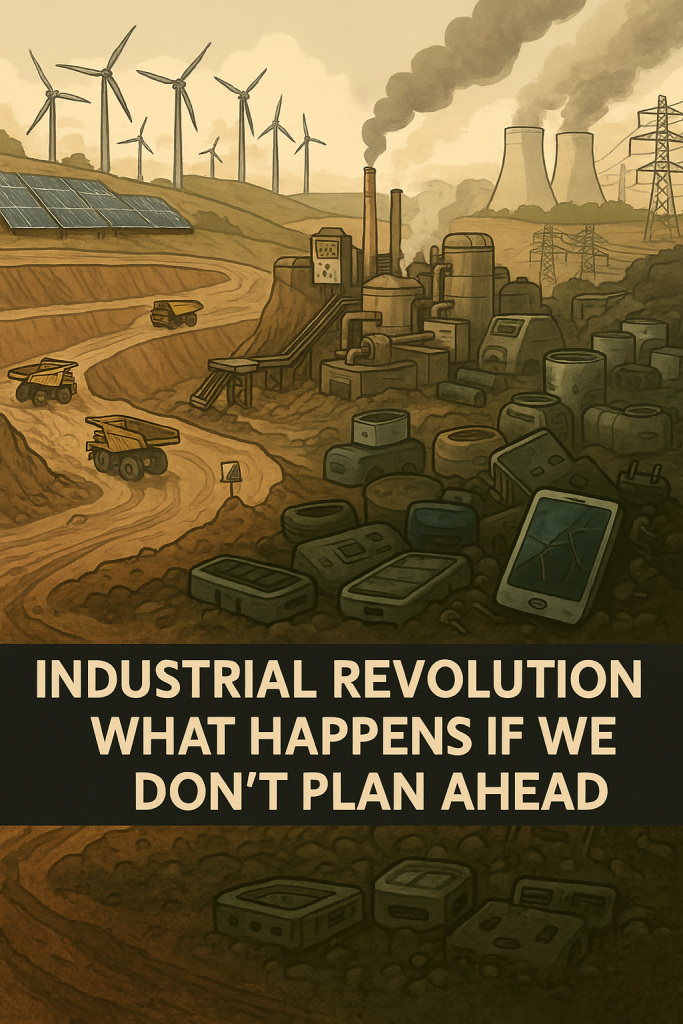
As you can see from the title, this post kicks off an Industrial Revolution 2.0 series. I’m going to walk through a bunch of topics that all tie into this new revolution: rare earth minerals, AI and robotics, electric vehicles, renewables and the energy grid behind them, plus the growing problem of electronic waste and pollution.
Looking at the image, you might think I’m predicting nothing but ecological destruction. That’s not the point. What I’m trying to show is what can happen if we don’t think through the full sequence of how this revolution is happening. If we don’t plan ahead, this is exactly where we can end up.
What made me decide to do this article is a previous post about the history of Pennsylvania and how it supplied the nation with its natural resources: “Pennsylvania: From Founding State to Resource Powerhouse (and What It Did to the Land — and How It Recovered)”.
This is not about refusing to use the resources we have to move forward. This is about needing to think things all the way through this time. Plan ahead. Learn from our mistakes in the previous industrial revolutions — and there were plenty, many of which we’re still dealing with.
Let’s do it right this time. I’m not saying we’ll get everything perfect, but we can definitely do better than last time.
What are Rare Earth Minerals
The rare earth elements (REE) are a set of seventeen metallic elements. These include the fifteen lanthanides on the periodic table plus scandium and yttrium.
They are an essential part of many high-tech devices.. The U.S. Geological Survey news release “Going Critical” explains:
Rare-earth elements (REE) are necessary components of more than 200 products across a wide range of applications, especially high-tech consumer products, such as cellular telephones, computer hard drives, electric and hybrid vehicles, and flat-screen monitors and televisions. Significant defense applications include electronic displays, guidance systems, lasers, and radar and sonar systems. Although the amount of REE used in a product may not be a significant part of that product by weight, value, or volume, the REE can be necessary for the device to function. For example, magnets made of REE often represent only a small fraction of the total weight, but without them, the spindle motors and voice coils of desktops and laptops would not be possible.
How do we get Rare Earth Minerals
Mining
There are two primary methods for REE mining, both of which release toxic chemicals into the environment. The first involves removing topsoil and creating a leaching pond where chemicals are added to the extracted earth to separate metals. This form of chemical erosion is common since the chemicals dissolve the rare earth, allowing it to be concentrated and then refined. However, leaching ponds, full of toxic chemicals, may leak into groundwater when not properly secured and can sometimes affect entire waterways.
The second method involves drilling holes into the ground using polyvinyl chloride (PVC) pipes and rubber hoses to pump chemicals into the earth, which also creates a leaching pond with similar problems. Additionally, PVC pipes are sometimes left in areas that are never cleaned up.
Both methods produce mountains of toxic waste, with high risk of environmental and health hazards. For every ton of rare earth produced, the mining process yields 13kg of dust, 9,600-12,000 cubic meters of waste gas, 75 cubic meters of wastewater, and one ton of radioactive residue. This stems from the fact that rare earth element ores have metals that, when mixed with leaching pond chemicals, contaminate air, water, and soil. Most worrying is that rare earth ores are often laced with radioactive thorium and uranium, which result in especially detrimental health effects. Overall, for every ton of rare earth, 2,000 tons of toxic waste are produced. This process involves extensive land disruption and chemical leaching, and even generates radioactive byproducts that require careful disposal.
Rare earths are usually mined in big open pits, where companies move huge amounts of rock because the rare earth content is low. They often crush and concentrate the ore near the mine, then ship that concentrate to specialized chemical plants. Those plants use strong acids and solvents to separate out each rare earth element, which is where most of the toxic and radioactive waste is created.
Note: Please take note of how toxic it is to mine and process Rare Earth minerals. This will be again talked about when I get to the piece of the electronic waste and polution.
Other methods of acquiring Rare Earth Minerals
Recycling electronic waste, extraction from Industrial and existing mining waste, Chemical and electrochemical extraction, Biological and physical extraction
Breakdown of how we get Rare Earth Minerals
Only 1 percent of rare earths currently recycled
So far I haven’t found a clear breakdown of how much of the global rare earth supply comes from sources other than traditional mining. What is obvious, though, is that mining still accounts for the vast majority of production. Most of the data I can find are reported by country and focus on mine production, not on recycling or other extraction methods.
The Politics of Rare Earthhes: Local to Global
Sigh, we can never get away from politics, can we? Even when the topic is something that should benefit all of us. To be clear, this is not meant to be a partisan rant. Well, maybe just a little. My point is simple: we have to find common ground here, and a lot of people aren’t willing to even try. If you’re not willing to join the conversation, you probably shouldn’t complain too loudly about the final decisions. The reality is that rare earth minerals are a necessary resource if we expect to move forward in our development, so we need to figure this out.
Local/State/National politics.
If you’ve read this far, then you already know about the environmental consequences that can occur when extraction and processing of rare earth minerals aren’t done right. That leads straight into the usual argument: yes, we need rare earths to “save the world” — but not where I live, not in my state. In other words, I want the benefits, but I don’t want anything connected to it happening anywhere near me. Sorry folks, this is the real world. Rare earth minerals are already heavily used for both consumer products and national defense. So either we learn to do without them, or we join the conversation about how to do this as safely and responsibly as possible. In the next section, I’m going to talk about what this “not in my backyard” attitude has actually caused by pushing the problem onto other places.
All of this leads straight into the politics of who mines, who processes, and who pays the price.
Global politics
This is where things get really scary. As a nation (the United States), we’ve outsourced much of our rare earth supply to other countries. We did this because nobody wanted to confront how things should be done when it comes to extracting and processing rare earths here at home. Now it has become both a national security issue and a potential tool for political and economic blackmail by those other countries.
From usg.gov is a breakdown of equivalent World Mine Production and Reserves. Just read who has the current largest mining and reserves when it comes to Rare Earth Minerals. That is correct, China. China has already tried to blackmail other nations with their Rare Earth supplies when they didn’t like another nations policies. Renmember,at our national defense is a huge user of Rare Earth Minerals. Trust me when I say this. if the shit ever hit’s the fan and it comes between the citizens and the armed forces getting priority to these minerals. The mlitary will win argument. We will not have a choice.
So, all nations need to have a solid stratigy on how to both acquire and process their rare earth needs. And the best way is to produce as much as possible locally.
Lets wrap this up
Let me repeat what I said at the very beginning: I am not against rare earth minerals or the things they’re used for. I also understand why people are worried about rare earths being mined and processed near where they live. But it’s still a fact that unless we’re willing to deal with this ourselves, we hand our freedom to those who control large reserves of rare earths and don’t share our concerns about what extraction and processing can do to the environment. If that happens, we will be blackmailed, we will lose leverage, and we will struggle to advance as a society.
So, what can we do? Use common sense when it comes to mining. Make sure it’s done as safely as possible. Be willing to pay higher prices if those common-sense solutions require serious investment in cleaner extraction and processing.
We also need to recycle our electronic devices. We’re a throw-away society. Fine — you want a new computer, phone, or TV every few years? Then make sure what you’re discarding is actually recycled. And not by some foreign operation that will 1) just sell the recovered minerals back to us, and 2) poison its own citizens in the process. There are already companies being built around recycling specific electronics and components, like EV batteries. I’m very glad to see that, because without proper recycling we’d repeat the same heavy-metal pollution disasters we saw from older batteries and other toxic devices that were simply thrown away.
Earlier in this article I talked about mining rare earths by moving huge volumes of earth and then separating out the useful materials. Does that remind you of anything from our past? That’s right—other types of mining we’ve already lived through. In the past, the waste was often left at the mine and everyone just moved on.
Now there’s research and small-scale work underway to recover rare earth minerals from that old mining waste. From what I’ve read, we could recover a significant amount of rare earths this way, alongside any new deposits we mine. There are two big benefits: less new mining, and old mine sites being cleaned up.
Let me say, I hope this truly becomes reality. One of the facts that came out of my previous article on Pennsylvania was that the state has the most abandoned mines in the nation. This could be a godsend to help clean up these sites faster.
All of these ideas come from lessons we’ve already learned in our own history. Even if you don’t like that history, it has still taught us what works and what doesn’t. The question now is whether we’re willing to listen to those lessons while we build Industrial Revolution 2.0.
Next up in this series: Industrial Revolution 2.0 (P2) – AI and Robotoics
Discover more from
Subscribe to get the latest posts sent to your email.