
In the last article I posted: Industrial Revolution 2.0 (P2) – AI and Robotics I closed with the following comment.
Increased energy usage and costs
As every industrial revolution has shown, energy is the fuel that makes everything else possible. And each new wave of technology has required more energy than the one before it. AI and robotics are no different. Both require huge amounts of power — from data centers running AI models to factories full of robots that never really “clock out.”
In this article, I’ll try to explain how our energy infrastructure is currently structured, why it isn’t ready for the increased energy usage required by AI and robotics, and what’s being done to try to fix that.
Please know that when it comes to renewables, I’m 100 percent behind them. I’m just not “renewables or nothing.” My belief about energy is that the more options we have, the better off we are. The wind doesn’t always blow. The sun doesn’t always shine. We get droughts. So there should always be other options for producing energy to pick up the slack.
There’s also something called a base load — the amount of energy that always has to be generated, even when other sources fall off. Right now, renewables are not at the stage where they can reliably maintain that base load on their own. I’m not saying renewables can’t get there; I think they can. But they’re not there yet. And with AI and robotics already using such huge amounts of energy, now is not the time to shut down all other energy sources and pretend we can run everything only on renewables.
If you’re reading this from outside the United States, a quick note up front: in this section I’m talking specifically about the U.S. electrical infrastructure. That’s the system that powers most of the AI data centers and robotics work I’m focusing on here. The details in your country will be different, but a lot of the big questions – “Can our grid keep up?” and “Who pays to upgrade it?” – are probably very similar.
Existing U.S. Energy Infrastructure
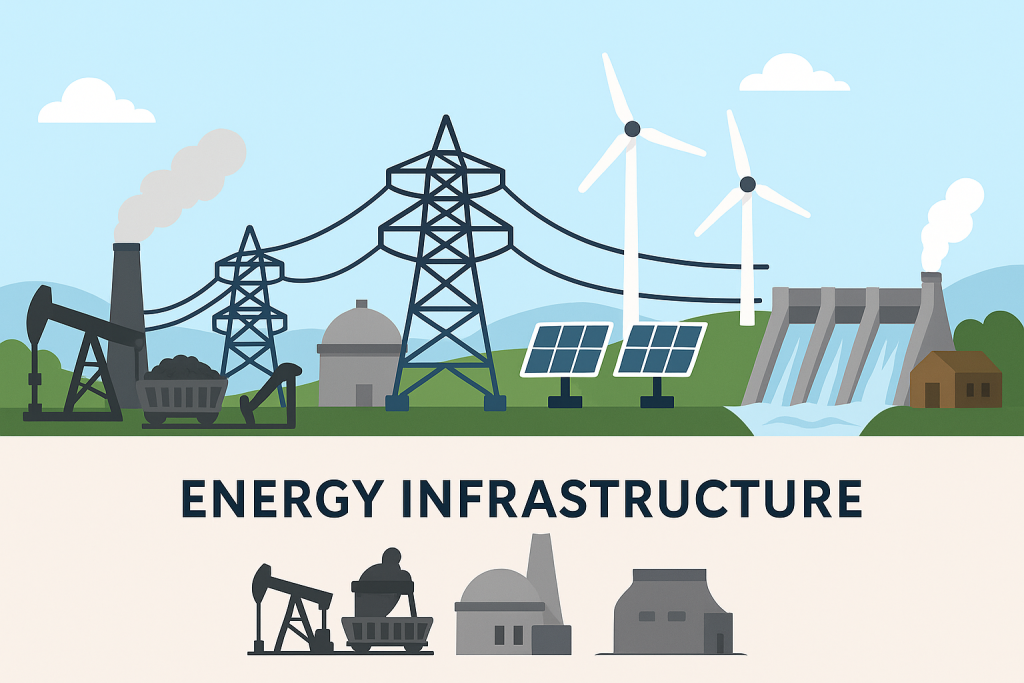
cisa.gov describes the U.S. electricity sector as a huge, interconnected system with thousands of power plants and more than a thousand gigawatts of installed generation. A mix of coal, natural gas, nuclear, hydro, oil, and renewables all feed into the same grid, and a lot of those fuels move around the country by rail and pipeline before they ever show up at your wall outlet. Just about every other industry depends on this one. When the power stops, everything else grinds to a halt very quickly. The people running the grid know this, and there has already been a lot of work on planning, preparedness, and sharing best practices across the sector.
The U.S. electricity segment contains more than 6,413 power plants (this includes 3,273 traditional electric utilities and 1,738 nonutility power producers) with approximately 1,075 gigawatts of installed generation. Approximately 48 percent of electricity is produced by combusting coal (primarily transported by rail), 20 percent in nuclear power plants, and 22 percent by combusting natural gas. The remaining generation is provided by hydroelectric plants (6 percent), oil (1 percent), and renewable sources (solar, wind, and geothermal) (3 percent). The heavy reliance on pipelines to distribute products across the nation highlights the interdependencies between the Energy and Transportation Systems Sector.
The reliance of virtually all industries on electric power and fuels means that all sectors have some dependence on the Energy Sector. The Energy Sector is well aware of its vulnerabilities and is leading a significant voluntary effort to increase its planning and preparedness. Cooperation through industry groups has resulted in substantial information sharing of best practices across the sector.
I’ve said before that our existing infrastructure is already being pushed close to its limits with today’s “normal” energy use. When you look at the government’s own description, you can see what a major task it’s going to be to upgrade all of this so it can handle both our current needs and the extra load from AI and robotics. This isn’t a brand-new problem. The need to modernize the grid has been talked about for years. AI and robotics just turn the dial from “we should really fix this” to “we can’t afford to keep putting this off.”
All of this has to be a coordinated effort between government (federal, state, and local) and the energy companies that actually own and operate the hardware. The cynic in me definitely wants to say: good luck with that. On top of the politics and the money, we also have the NIMBY factor (“Not In My Back Yard”). A lot of those concerns are understandable. People don’t want massive power lines, new plants, or big industrial sites dropped next to where they live, and they worry about safety, health, and property values.
The job for people like me – and maybe you – is to help keep this conversation honest. We need to be able to say, “Yes, there are real impacts and risks,” while also saying, “If we block everything everywhere, we’re going to fall behind.” Everyone has to listen and be willing to compromise: communities, engineers, regulators, and the companies building AI and robotics. If we don’t, we’ll end up watching other places enjoy the benefits while we’re still arguing over whether to even plug the future in.
Why the U.S. Energy Infrastructure needs to be upgraded
I have repeatedly stated that the U.S. energy infrastructure needs to be upgraded. Here are some of the reasons why.
wisc.edu provides the following explanation. Which honestly, pretty much says everything.
The U.S. electric grid, which consists of three main interconnections and delivers power to millions, is reaching a critical juncture. Much of the infrastructure was built 50-75 years ago and is struggling to keep up with modern energy demands, weather events, and the transition to renewable energy. As outages become more frequent and maintenance costs rise, the need for a comprehensive modernization strategy has never been more urgent. This issue has been a top priority for utilities for the last decade.
Many components of the U.S. electric grid date back 40 to 70 years, well beyond their intended lifespan. While the grid has been expanded and updated over time, the core infrastructure remains outdated.
Transmission Lines, Power Transformers, and Substations. Those are the three main areas where we need to upgrade.
Just upgrading the transmission lines alone will take a huge amount of time. This is also an area where I expect a lot of pushback from people. One of the big concerns about transmission lines is the health risk of living near high-voltage lines. Those health concerns have to be taken seriously and addressed as part of any upgrade plan. Existing lines that are already in place and at the end of their life absolutely need to be replaced.
But when it comes to building new transmission lines, we need to plan carefully where they go.
They need to be able to supply power to the areas that actually need it.
Health risks have to be considered when deciding how close they are to populated areas.
Environmental impacts on wildlife have to be considered when they run through rural or undeveloped areas.
Power transformers are another weak spot. Just look at what sits up on a lot of our power poles. A lot of those transformers are old as dirt. They contain toxic chemicals, and when they fail, they can and do explode. When one blows, it lights up the sky and you’re left hoping that nobody was hurt and nothing nearby caught fire.
Substations are the same story: another example of our aging infrastructure sitting in plain sight. A chain-link fence, a yard full of equipment, and that’s about it. You can tell, just looking at many of these sites, that they’re straight out of the 1950s or thereabouts. They were never designed for the kind of loads and expectations modern society is putting on them.
I’ve actually worked for a utility in the IT area. It was a gas utility, but the next point I’m raising cuts across all energy companies: cybersecurity. From what I saw:
The government takes this very seriously.
The energy companies take this very seriously.
And it is a very real threat, based on the actual number of attempts to breach IT security.
One thing I did not see strongly addressed in the references I’ve looked at is physical security of the energy infrastructure. A lot of these substations are still guarded by a simple chain-link fence, maybe with some cameras. And if you read the news, there are already stories of people damaging substations and other assets. So the physical threat is real too.
Now to the cost. All you have to do is look at the size of the energy infrastructure described earlier to recognize that:
It will be expensive.
It will not happen overnight.
Like it or not, this has to be addressed. And if it isn’t, even without considering AI, we’re going to see more and more power outages. The number of outages is already higher than what many of us grew up thinking of as “normal.” Add in natural disasters on top of that, and a fragile energy structure can be crippled very easily.
In Conclusion
Even though I didn’t spend a lot of time directly on AI and robotics in this part of the series, energy is a major part of both. Everything has to be tied together. The energy needed to power these new capabilities has to be there, and right now it isn’t.
On top of that, the energy needed just to sustain our current society is already being stretched thin. That alone means we have to address the energy infrastructure anyway. So if we’re going to have to deal with it no matter what, then we should do it right and plan for the future at the same time.
Now, let’s look at what has already happened to help both the energy infrastructure and pollution.
Every new electronic product we buy now is more efficient than it used to be. That means less load that has to be supported and less pollution from producing that energy.
Major AI companies are already doing their part too. It may not be obvious from the outside, but they custom design and build their own servers to optimize performance, energy efficiency, and cost for their specific services. Google was one of the pioneers in this kind of planning, and the big AI companies have followed in their footsteps. These high-energy server farms are also looking at other ways to cut back on energy costs by tackling one of their biggest problems: cooling. Servers are electronic, and electronics generate a lot of heat. In the past, this was handled with high-cost air conditioning—another big energy user. Now there are early experiments with using water to cool servers, or placing server farms in underground abandoned mines and caves where the temperature stays more constant.
If you’ve read any of my other posts, you already know I’m very interested in history. When I look back at earlier industrial revolutions, one thing that jumps out is that major manufacturers used to build their own power plants on site. Today, I know the main focus for these companies is investing in AI development and building the server farms they need for current and future use. But with small nuclear power plants now being developed, I think it might be worth revisiting that older idea in a modern way: clusters of server farms from different companies located closer together, pooling resources to have their own dedicated power plant built around small nuclear reactors. I can see a lot of advantages to this kind of strategy for both the AI companies and the energy companies. If the AI companies don’t want to build or run these plants themselves, they could still pool their resources and contract energy companies to do what they’re already good at. That could ease some of the national strain from both upgrades and ongoing energy consumption.
There are, of course, disadvantages too. Concentrating that much critical infrastructure in a smaller number of locations raises the stakes for both physical and cyber security. A problem at one of these sites wouldn’t just knock one company offline, it could hit several at once. Even with those risks, I still think it’s an idea worth putting on the table and seriously considering as part of the bigger conversation.
As a final note on how we might be able to tackle the energy infrastructure upgrade: use AI. AI would be perfect for bringing all of the parameters together and developing plans within specific requirements for this upgrade. I know more than a few engineers who would balk at that because it might feel like they’re losing control. But they wouldn’t be. They would be the ones defining the requirements, and they would still have to be the ones who sign off on the plans. What AI can do is speed up the process—especially when you consider how many different energy companies there are and how each one might otherwise try to address this upgrade in its own way.
Next up is the final piece in this series: pollution and Industrial Revolution 2.0, the wrap-up.
This is a topic I take very seriously. We’re already living with the pollution left behind by earlier industrial revolutions, we’re still creating new pollution today, and we risk piling even more on top of that if we don’t build real cleanup and waste-handling plans into this new wave of AI and robotics from the start. For me, this isn’t an abstract “environment” discussion. It’s about the air kids breathe, the water people drink, and the long-term damage we’re quietly locking in if we keep treating pollution as an afterthought.
So in the final part of this series, I’m going to look at three things: the mess we inherited, the mess we’re making right now, and the mess we’ll create if we let AI and robotics grow without thinking about the physical footprint that comes with them. Consider this your warning label before we dive in.
Because of the holidays, I’m holding the final part of this series until the new year. I might do a light-hearted post in between, but I’m not promising anything — so if you don’t see another post before then, happy holidays.