
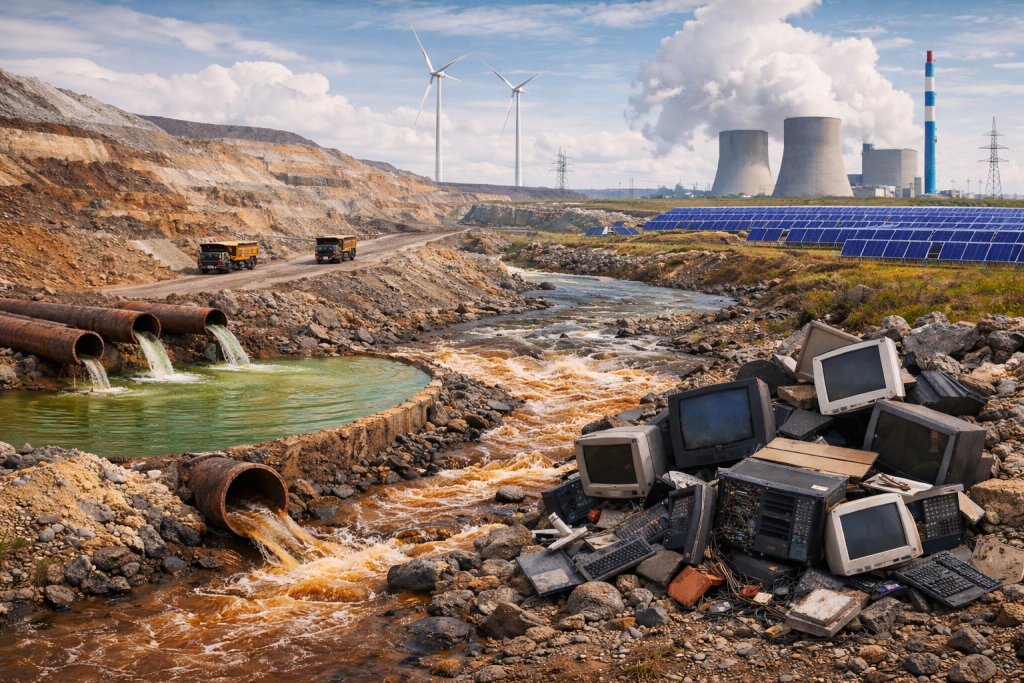
This is the final installment in the Industrial Revolution 2.0 series, and in this article I’m going to address pollution. Pollution has been the nemesis of every Industrial Revolution—and this one is no different.
I’ve tried to be honest with you throughout this series by stating up front that I fully support this Industrial Revolution, while still laying out both the good and the bad.
Now we’re at what I consider the bad of every Industrial Revolution: pollution. I warned you earlier that I wasn’t going to hold back on what I think about this. And you’re about to find out I have some hard-core feelings about pollution—and they aren’t good.
In another article I talked about how Pennsylvania helped power the nation through the 1700s, 1800s, and 1900s. But what came with that was the damage—land, water, and air hit hard. Abandoned mines still pollute water supplies. Mine waste still poisons soil. Hillsides stripped bare still carry scars. A lot of this is still being addressed and cleaned up. And unfortunately, I’m already seeing the same pattern in this Industrial Revolution.
Lets get to it. What types of pollution do we have to worry about with this Industrial Revolution.
- The process of separating Rare Earth minerals from the rest of the mined output. This is very toxic and dangerous solution. I give you an article about the nation that supplies the largest quantiles of rare earth minerals. That would be China. China’s rare earth mining boom leaves toxic legacy in water and soil As a nation, we can not rely on a hostile goverment to supply our needed rare earth supplies. But we need to be honest and not make the mistakes they quite obviously are making and not caring about.
- Supplying energy for any industry has always been a pollution source. We still use coal, natural gas, renewables, and nuclear. Coal pollutes through mining and generation. Natural gas pollutes through extraction and generation. Nuclear raises issues through uranium mining and long-term waste disposal.
- E-waste. This Industrial Revolution runs on electronics—from data centers to the gadgets people love. And when we upgrade, replace, and discard all of it, the waste doesn’t just vanish.
As a nation, I believe we’ve learned from previous Industrial Revolutions when it comes to pollution. We now have regulations in place to deal with two major sources: the mining and processing of ore needed to supply this revolution, and the generation of the energy required to power it.
On the energy side, we’re addressing the problem in a number of ways. Efficiency: manufacturing and products are far more energy-efficient than ever before, and still improving. Energy production: we’re building cleaner and more efficient ways to generate power, from renewables to a renewed push for nuclear. New nuclear plants are being planned, smaller nuclear plants are being planned, and there’s even talk of reusing retired military reactors from submarines and aircraft carriers.
Even with all these improvements, there will still be pollution generated. We need to acknowledge that and address it as soon as it starts happening—not wait until it’s overwhelming.
Now for the lessons we still haven’t learned: e-waste.
E-waste is simple to explain. We throw electronics away the moment we want something newer and prettier. And remember the toxicity of rare-earth processing? The devices we toss are toxic too.
I’m having a hard time not going off into a nasty rant about this—because how many of the things we throw away are still functional? Why aren’t we repurposing them for other jobs? Why aren’t we getting them into the hands of people who could actually use them? And for crying out loud, why aren’t we recycling them?
Here’s the part a lot of people don’t realize: your discarded electronics contain precious metals.
Precious metals you’ll actually find
- Gold (Au) – connector plating, edge fingers, bonding wire (older chips), some PCBs
- Silver (Ag) – solder, contacts, some switches, conductive pastes
- Platinum (Pt) – small amounts; more common in certain sensors/industrial electronics than in everyday PCs
- Palladium (Pd) – very common in MLCC capacitors (older formulations especially) and some plating
Platinum-group metals (PGMs) you might see in smaller traces
- Rhodium (Rh) – occasional high-wear contacts/plating (more niche)
- Ruthenium (Ru) – some thick-film resistors, certain coatings
- Iridium (Ir) – niche/high-reliability uses
Not “precious,” but the big money movers in e-waste
- Copper (Cu) – the heavyweight: wiring, PCB traces, motors, transformers
- Tin (Sn) – solder
- Nickel (Ni) – plating, batteries, alloys
- Aluminum (Al) – frames, heat sinks, some wiring
- Zinc (Zn) – coatings, alloys
- Cobalt (Co) / Lithium (Li) – mostly batteries (phones/laptops), not so much desktop PCs unless there’s a battery
Other “valuable” metals commonly recovered
- Tantalum (Ta) – tantalum capacitors (especially older boards/phones)
- Indium (In) – displays (ITO coating), some semiconductors
- Gallium (Ga) – LEDs, RF chips (GaAs/GaN)
- Germanium (Ge) – fiber optics, some semiconductors (less common)
We’re throwing away money, people. Seriously—go look up the current prices of those metals and tell me how it makes sense that we treat old electronics like trash. What we need in this country is a modern version of scrappers, but for e-waste: folks who can pick up discarded TVs, PCs, phones, and server gear and make a living getting it into the right recycling pipeline. That pipeline is the part we still don’t fully have—because even though e-waste recycling is starting to take shape, we still don’t have a real, nationwide infrastructure built for it. And we can’t keep offshoring this job to poorer countries so they get stuck handling the toxic mess while they recover the valuable metals and we just keep buying new stuff.
Series Wrap Up
When I think about this Industrial Revolution, I think of it as the electronics revolution. It’s been building for years—maybe decades—and it feels like it keeps accelerating. Electric cars. Phones with more computing power than what it took to put men on the moon. 3D games that look almost real. AI showing up everywhere, from chatbots to science research. People connecting instantly across the world to trade ideas. And the biggest part? These changes aren’t limited to elites or scientists anymore. They’re reaching almost everyone, and they keep getting more affordable.
A lot of these advancements really do make life better—easier, faster, and more enjoyable. But every leap forward has a shadow side. Social media can bring people together, but it can also divide them. AI is replacing jobs, and that scares people for good reason. And of course, militaries around the world adapt new technology too, creating more efficient ways for humans to kill each other from farther away.
In the end, I’m not afraid of this Industrial Revolution. I think it’s a net positive for humanity. Cleaner, more efficient ways to produce energy can help raise the standard of living in places that have been left behind for generations. AI and robotics can take on work that is dangerous, exhausting, or painfully slow—jobs that chew people up, or projects that take forever to complete without help.
The one thing that truly worries me about this revolution is pollution. We’ve learned lessons from the past when it comes to mining, manufacturing, and regulation. But when it comes to everyday people—regular consumers—we still act like knuckle-draggers. We don’t seem to see the destruction we cause as individuals: wasted food, discarded products, and materials that could be reused, repaired, or passed on to someone who needs them. Every new product needs a new kind of awareness—what happens to it when it no longer serves its original purpose. It’s time to stop being a throwaway society. We should value each advancement as it happens, and make sure it isn’t wasted when the first use is over. Even if the original purpose is gone, find another use. Repair it. Repurpose it. Or recover the materials and build something new from them.
Recycle.
Discover more from
Subscribe to get the latest posts sent to your email.