
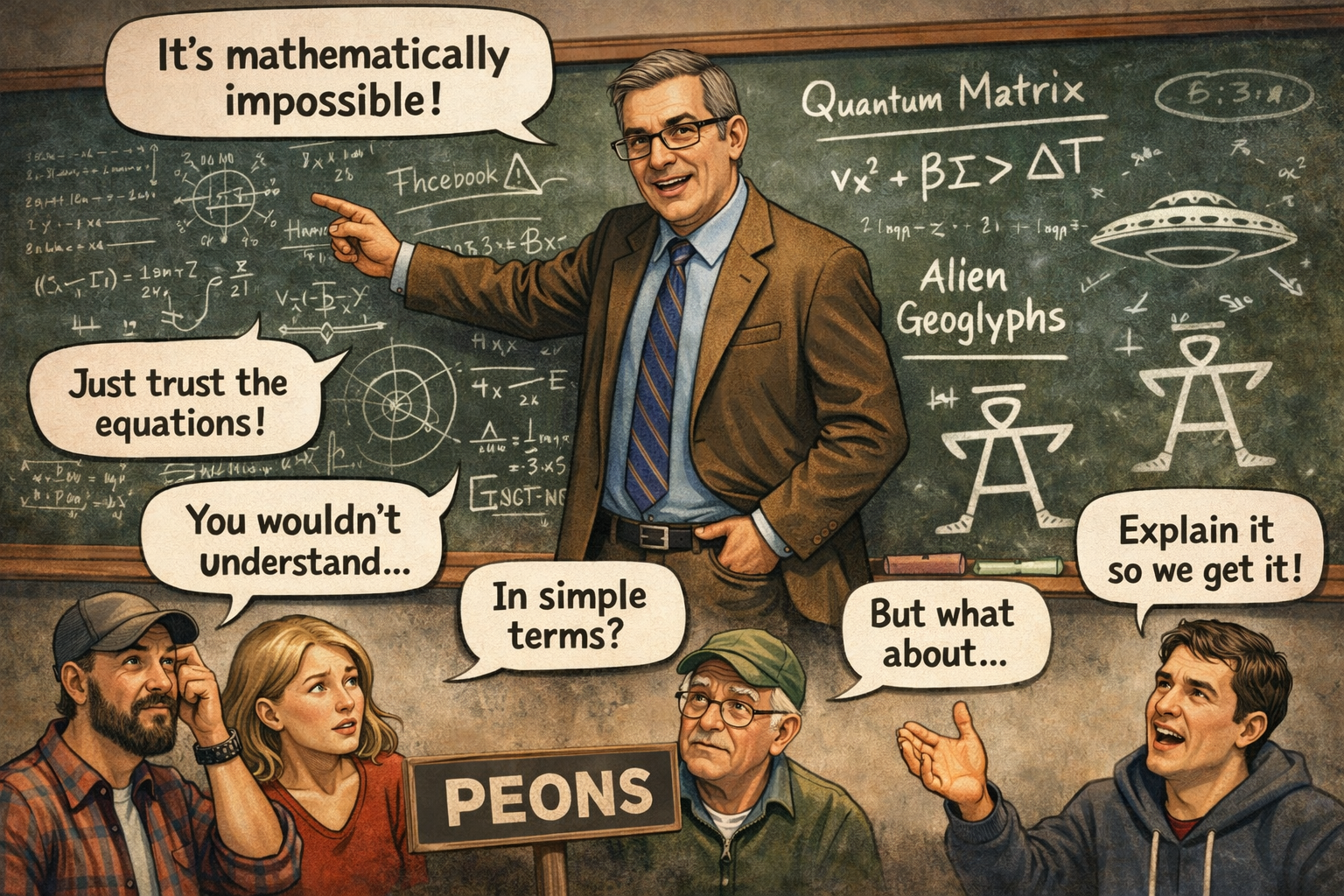
It’s a new year and I know I should be posting something positive ad all that. Sorry, not in the mood. So, I thought I would take on a topic that we all have probably encountered. Either in the news or first hand.
Experts and how they like to belittle us or talk down to us when we ask for explanations. You know how it goes. Either don’t explain something in simple terms. Using big words to talk over us. Get on their high horse when we ask questions.
First off: I do take the time to read up on subjects I don’t understand. I do try to read multiple sources so I can hear more than one side.
Yeah, I’ll admit it — on certain topics I can slip into “tin foil hat” territory. But not to the point where I’m refusing reality. If I’m wrong, fine. Tell me I’m wrong. I can live with that.
What I can’t stand is being talked down to.
If you can explain something in plain English, then explain it in plain English. Don’t put on a condescending tone and hide behind terms that aren’t even relevant to the person you’re talking to. Because at that point, you’re not educating — you’re performing.
Example #1: Nazca-style line drawings (Peru)
These are massive animal and line drawings in Peru that are easiest to appreciate from above. Tin-foil folks love to claim they were made for visitors from other planets.
Now, I’m not saying I ever fully bought that. But I did question the standard “expert” response, because the response always felt like this:
“Ancient people did it. Next question.”
Okay… how?
That’s the part we kept not getting. Not because it’s some “mystery,” but because the explanation was delivered like we were annoying for even asking.
Then you get a simple demonstration — the kind of thing the Discovery Channel has shown — where people recreate Nazca-style techniques using basic tools: laying out long straight lines with stakes and rope, using grids and reference points to scale shapes, and clearing surface stones to reveal a contrasting layer underneath. Suddenly it’s not mystical. It’s not aliens. It’s planning, surveying, patience, and manpower.
And here’s the part that drives me nuts:
If a regular TV crew can demonstrate it in a way the average person understands, then the “experts” could have explained it too. They just didn’t bother. Or they didn’t know how to translate it for normal people — which is a problem in itself.
Because the moment you refuse to explain, you don’t just “win the argument.” You create the exact vacuum that conspiracy thinking loves to fill.
Example #2: “Nothing Can Go Faster Than Light”… So Why Is the Universe Expanding Faster Than Light?
Ok, hereis the explanation that ChatGPT has provided for this. Which, I still haven’t really bought into yet. And i will explain my position on this after Ai’s explanation.
The point in plain English
When experts say “nothing can travel faster than light,” they mean nothing can move through space faster than light in its local neighborhood.
But the universe expanding isn’t “stuff moving through space.” It’s space itself stretching. That stretching can make distant galaxies get farther away from us so fast that their recession speed (distance increasing per unit time) is greater than the speed of light.
That doesn’t break relativity because:
- Locally, nearby objects still obey the speed limit (no ship rockets past a light beam next to it).
- The “faster-than-light” part happens over huge distances because the space between us and them is growing.
My issue with the explanation (and why I’m not fully sold)
Here’s what ChatGPT (and plenty of experts) will say: “Nothing can travel faster than light through space, but space itself can expand so fast that distant galaxies ‘recede’ faster than light.” Okay. I understand the words.
But I’m still not totally sold — and here’s why.
These explanations are built on mathematical models. And math is real. I’m not arguing that. What I am saying is that “math” isn’t one single thing with one single interpretation. There are different branches, different frameworks, different ways to model reality — and they don’t always lead to the same conclusions unless you agree on the assumptions.
We’ve been building new math for centuries. Just look at the history of mathematics: wave after wave of “new tools” created because old tools weren’t enough to describe something. So are we really saying we’re done? That we’ve reached the final form of math and the final form of understanding?
Because sometimes the vibe I get from experts is: “The model says it, therefore it’s settled — and if you question it, you’re ignorant.” And that’s where I push back. I’m not refusing reality. I’m asking for the part they skip: what assumptions make the model true, what would break it, and what we actually know from observation versus what we infer.
Explain that in plain English, and we’re good. Talk down to people and act like the math is a mic drop, and you’re just feeding the very “tin foil” culture you claim to hate.
Example #3: Time Travel — When Experts Cherry-Pick the Math
This is where experts really get on my nerves, because they’ll act like “time travel” is one dumb idea with one dumb answer. Then they’ll cherry-pick whatever math supports the mood they’re in.
If they want to sound serious and shut the conversation down, you’ll get:
“Time travel is impossible.”
But if they want to sound clever, you’ll get:
“Well technically… relativity allows time dilation…”
So which is it? Impossible, or technically allowed?
Here’s the part the public usually doesn’t get told in plain English: there are two completely different things people mean by time travel, and mixing them together is how experts get to win arguments without actually explaining anything.
1) “Time travel” to the future (the boring kind)
This one is real. It’s time dilation. If you move really fast or you’re near strong gravity, you can experience time differently than someone else. You “travel to the future” in the sense that you age less than other people.
Experts love this version because it’s safe. It makes them look smart. And it lets them say, “See? Science!”
2) “Time travel” to the past (the one everyone actually argues about)
Again, I give you what gadget(ChatGPT) provided as an explanation. Which is better than any explanation I have heard any expert opinion that I have heard or seen written.
This is where experts really get on my nerves, because they’ll act like “time travel” is one dumb idea with one dumb answer. Then they’ll cherry-pick whatever math supports the mood they’re in.
If they want to sound serious and shut the conversation down, you’ll get:
“Time travel is impossible.”
But if they want to sound clever, you’ll get:
“Well technically… relativity allows time dilation…”
So which is it? Impossible, or technically allowed?
Here’s the part the public usually doesn’t get told in plain English: there are two completely different things people mean by time travel, and mixing them together is how experts get to win arguments without actually explaining anything.
1) “Time travel” to the future (the boring kind)
This one is real. It’s time dilation. If you move really fast or you’re near strong gravity, you can experience time differently than someone else. You “travel to the future” in the sense that you age less than other people.
Experts love this version because it’s safe. It makes them look smart. And it lets them say, “See? Science!”
2) “Time travel” to the past (the one everyone actually argues about)
This is the one that gets the eye roll. Going back. Changing something. Creating paradoxes.
And here’s where the cherry-picking happens.
Because the honest answer isn’t “impossible.” The honest answer is:
- There are mathematical solutions in physics that seem to allow weird paths through spacetime under extreme conditions.
- There are also big reasons to think nature might not allow it.
- And we don’t have real-world proof of backward time travel.
That’s a very different message than “LOL, no.”
But instead of saying that, a lot of experts just pick the conclusion that makes them sound confident. And that’s the part that feels dishonest.
What bugs me isn’t skepticism — it’s the attitude
If you want to say “we don’t think backward time travel is physically possible,” cool. That’s a reasonable position.
But don’t pretend the discussion is settled because you dropped one equation like a mic and then acted like anyone asking questions is stupid. That’s not education. That’s ego.
If the math is complicated, fine. But then translate it:
- What assumptions are required?
- What evidence do we actually have?
- What would it take to prove it wrong or right?
Because when experts refuse to explain, all they do is hand the topic over to the loudest conspiracy voice in the room.
The real answer (plain English)
- Math models aren’t reality. They’re tools we use to describe reality.
- A model is “true” only in the sense that it matches observations within some range and assumptions.
- Science doesn’t say “final.” Science says: best explanation so far, with known limits.
So the honest question isn’t “Is this the final math?”
It’s: How strong is the evidence, and how dependent is the conclusion on assumptions?
What we can accept without “bowing down”
We can say:
- “Given today’s evidence and the current framework, this explanation fits best.”
- “Here are the assumptions it relies on.”
- “Here’s what could overturn it.”
That’s a totally reasonable stance that doesn’t require worshipping experts.
Even with Gadget’s explanation, I still see it the same way I see the faster-than-light argument. The explanation is built on today’s mathematical models, and I’m not denying that math is real.
But do we really treat today’s models like the final answer?
History doesn’t work that way. We’ve refined and rebuilt our tools over and over. Sometimes the math stayed and our interpretation changed. Sometimes new approaches showed limits we didn’t see before. So I’m not saying “the experts are wrong.” I’m saying: don’t talk like the conversation is over just because the current model gives you a clean answer.
Give us the assumptions. Give us the boundaries. Tell us what would change your mind. That’s how you educate people instead of shutting them down.
In Closing
Here’s my message to the experts: climb down off the ivory tower if you don’t want falsehoods to spread.
Stop talking to people like we’re stupid. Drop the condescending tone. Translate your assumptions into plain English. If you do that, I might still disagree — but I’ll respect the effort, and I’ll spend more time learning.
When you talk down to people, you don’t educate them. You push them away. And that’s not just annoying — it’s arrogant, it’s ignorant, and it helps misinformation grow.